Technology
Not Just GPT
For Factories
Your manufacturing AI is a tiered system where deterministic quantitative AI does the heavy lifting. The LLM layer exists only to translate—not to decide.
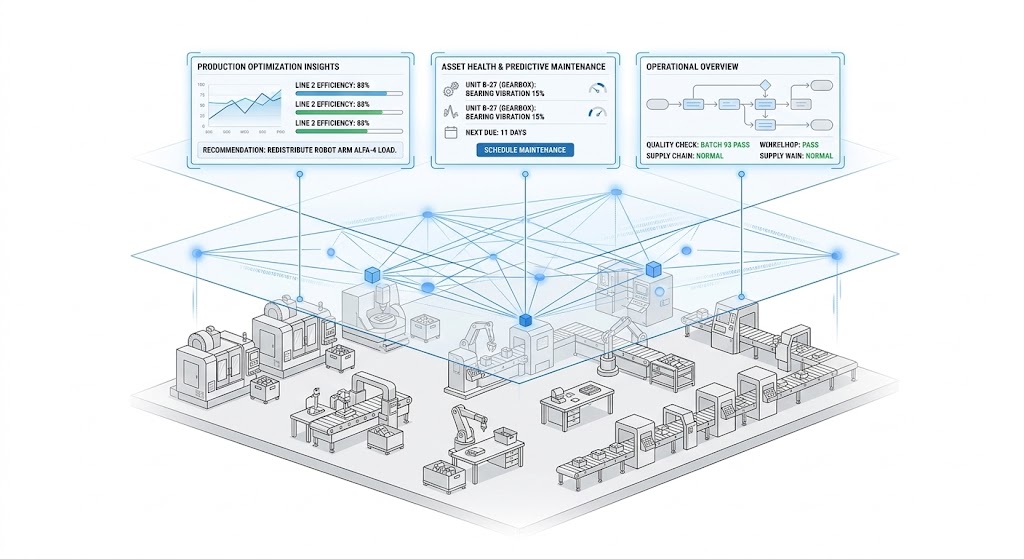
Technology
Your manufacturing AI is a tiered system where deterministic quantitative AI does the heavy lifting. The LLM layer exists only to translate—not to decide.
The Difference
Most "AI for manufacturing" products are thin wrappers on generic LLMs. IronTwin is built different.
Foundation Layer
Your factory's structure encoded as a knowledge graph. Every machine, process, and relationship mapped.
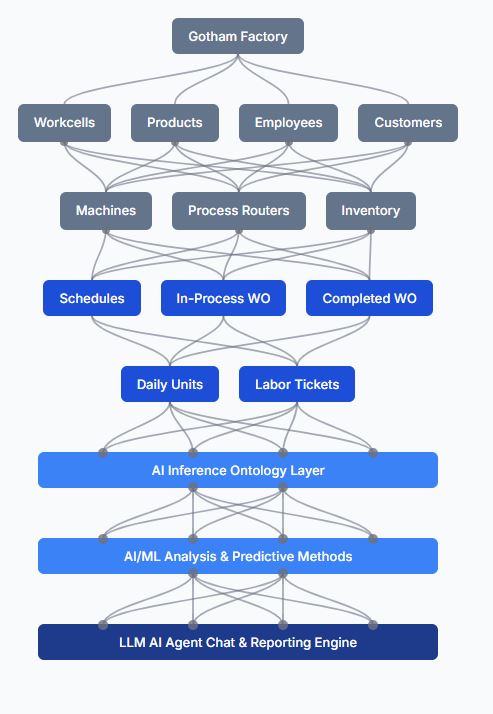
Factory → Lines → Workcells → Machines. Every level connected and queryable.
Upstream/downstream dependencies, shared resources, and material flows encoded.
Historical states, shift patterns, and maintenance windows all part of the model.
New equipment detected and integrated automatically from data streams.
Intelligence Layer
Deterministic AI engines with calibrated confidence. Know what to trust and when to verify.
Not black-box ML. Equations calibrated to your specific manufacturing performance curves.
OEE = f(speed, quality, availability)Bayesian methods that update beliefs with new data. Predictions improve automatically.
P(failure | observations)Production rate predictions, demand forecasting, and trend detection with confidence bands.
Forecast ± 95% CINot just an answer—you get the probability that the answer is correct. Critical for knowing when human review is needed.
Translation Layer
The LLM doesn't decide. It translates quantitative outputs into human-readable recommendations.
{ "oee_delta": -0.12, "root_cause": "speed_loss", "conf": 0.89 }Architecture Summary
Each layer builds on the one below. Decisions flow up through physics, statistics, and uncertainty before reaching language.
Factory ontology, relationships
Physics-based, calibrated models
Confidence intervals, risk scoring
Natural language translation
See It In Action
Join the manufacturers who are turning data into decisions—not just dashboards.
Book a 15-Minute DemoNo commitment required. Prove value before you commit.